
- Overview
- AI in Game Design
- Non-Player Characters and Behavior
- Adaptive Narratives and Player Choice
- Player Modeling and Personalization
- Games as Simulated Worlds
- Creativity and User-Generated Content
- Competitive Gaming and Skill
- Ethics and Power in Game Worlds
- Cultural Significance of Games
- Redefining Games in the AI Era
- See Also
- FAQ
Overview
Games in the AI Era examines how artificial intelligence transforms game design, player experience, virtual worlds, and the cultural role of games. AI systems increasingly shape how games are created, how worlds respond to players, and how narratives unfold.
In the AI Era, games evolve from fixed systems into adaptive, intelligent environments.
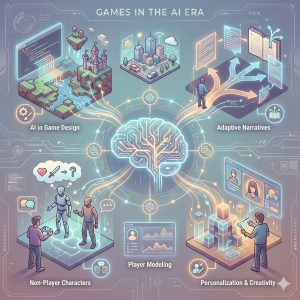
AI in Game Design
Artificial intelligence has long been used in games, but its role has expanded significantly in the AI Era.
AI is now applied to:
- procedural generation of levels and environments
- dynamic balancing of difficulty
- automated testing and content creation
- simulation of complex game systems
These tools allow developers to create larger and more responsive worlds with fewer manual constraints.
Non-Player Characters and Behavior
One of the most visible impacts of AI in games is the evolution of non-player characters (NPCs).
AI-driven NPCs can:
- adapt behavior based on player actions
- engage in natural language interaction
- exhibit memory and persistence
- simulate social relationships and motivations
This shifts NPCs from scripted obstacles to interactive agents.
Adaptive Narratives and Player Choice
In the AI Era, storytelling in games becomes increasingly dynamic.
AI enables:
- branching narratives generated in real time
- personalized storylines based on player behavior
- emergent plotlines not predefined by designers
As a result, games move away from fixed narratives toward co-created experiences.
Player Modeling and Personalization
AI systems analyze player behavior to tailor experiences.
This includes:
- adjusting difficulty and pacing
- recommending in-game content
- personalizing challenges and rewards
While personalization can enhance engagement, it also raises questions about manipulation and agency.
Games as Simulated Worlds
AI-driven games increasingly function as complex simulations rather than static rule sets.
These worlds may include:
- autonomous ecosystems
- evolving economies
- persistent social structures
Such systems blur the line between games, simulations, and virtual societies.
Creativity and User-Generated Content
AI tools expand player creativity by enabling:
- generation of characters, items, and environments
- natural language modding and world-building
- collaborative creation between players and systems
Games become platforms for creative expression rather than closed products.
Competitive Gaming and Skill
AI also affects competitive play by:
- assisting training and strategy analysis
- detecting cheating or unfair play
- redefining what constitutes skill and mastery
In some cases, AI systems outperform human players, challenging traditional benchmarks of expertise.
Ethics and Power in Game Worlds
The increasing intelligence of game systems raises ethical concerns related to:
- data collection on player behavior
- psychological influence and engagement optimization
- ownership of AI-generated in-game assets
- control over virtual economies and rules
Games in the AI Era reflect broader power dynamics present in digital systems.
Cultural Significance of Games
Games serve as cultural laboratories where new forms of interaction, identity, and governance are tested. In the AI Era, games:
- model future social systems
- normalize interaction with intelligent agents
- influence expectations of autonomy and control
They play a central role in shaping how societies imagine AI-mediated worlds.
Redefining Games in the AI Era
Games in the AI Era are no longer defined solely by rules or objectives. They are evolving systems shaped by continuous interaction between players and intelligent agents. This transformation redefines:
- authorship and control
- play and participation
- the boundary between game and world
See Also
- Culture in the AI Era
- Art in the AI Era
- Music in the AI Era
- Society in the AI Era
FAQ
How does AI change games?
AI enables adaptive worlds, intelligent characters, and personalized experiences.
Are AI-driven games less predictable?
Yes. AI introduces emergent behavior that cannot be fully scripted.
Do AI systems replace game designers?
AI supports design but does not replace human creative direction.
Are games becoming simulations of real life?
Many AI-driven games increasingly resemble social and economic simulations.
Last updated: 2026