
Overview
The AI Era refers to a historical period in which artificial intelligence becomes a general-purpose force shaping society, work, culture, and human decision-making. Unlike earlier phases of computing, AI in this era is not limited to narrow tasks or specialized domains. It increasingly influences how knowledge is created, how value is produced, and how institutions function.
The AI Era is defined not by a single invention, but by the widespread integration of machine intelligence into everyday systems.
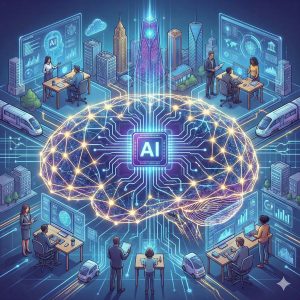
What Defines the AI Era
Several characteristics distinguish the AI Era from previous technological periods:
- artificial intelligence systems capable of generating text, images, code, music, and decisions
- rapid diffusion of AI into consumer, professional, and institutional tools
- automation of cognitive tasks, not only physical labor
- learning systems that adapt based on data and feedback
- declining cost of analysis, synthesis, and expertise
Together, these shifts change how humans interact with information and with each other.
From Tools to Cognitive Infrastructure
Earlier technologies extended human physical or computational capacity.
In the AI Era, intelligent systems increasingly act as cognitive infrastructure.
AI systems now:
- filter and rank information
- assist or replace human judgment in decisions
- influence attention, preferences, and beliefs
- mediate creative and intellectual work
As a result, understanding AI becomes a form of literacy rather than a specialized skill.
Core Domains of Impact
The effects of the AI Era can be examined across several major domains.
Life in the AI Era
Artificial intelligence reshapes daily life, identity, relationships, health, parenting, creativity, and personal autonomy.
Work & Society in the AI Era
AI transforms employment, education systems, healthcare, governance, elections, and economic power structures.
Culture in the AI Era
Creative expression, art, films, music, games, and storytelling increasingly involve human–AI collaboration.
These domains are interconnected and evolve simultaneously.
How the AI Era Differs From Previous Technological Revolutions
The AI Era differs from industrial and digital revolutions in key ways:
- Speed: AI capabilities evolve faster than social and legal institutions
- Scale: AI systems operate globally by default
- Opacity: decision processes are often difficult to interpret
- Autonomy: systems act with limited human supervision
- Feedback loops: AI shapes the data it later learns from
These features introduce new forms of risk alongside new opportunities.
Intelligence, Creativity, and Power
The AI Era blurs traditional boundaries between:
- human and machine intelligence
- creation and automation
- expertise and access
Creativity becomes scalable, expertise becomes cheaper, and power concentrates around those who control data, models, and infrastructure. These shifts raise questions about agency, accountability, and governance.
Open Questions of the AI Era
Despite rapid adoption, many questions remain unresolved:
- How should societies govern systems they do not fully understand?
- Which skills remain uniquely human in an AI-assisted world?
- How can trust and accountability be preserved?
- Who benefits from AI-driven change, and who is excluded?
The AI Era is ongoing, and its long-term outcomes remain uncertain.
See Also
- Work & Society in the AI Era
- Education in the AI Era
- Life in the AI Era
- Culture in the AI Era
FAQ
What is the AI Era?
The AI Era is a period in which artificial intelligence becomes a central force shaping society, work, culture, and human decision-making.
When did the AI Era begin?
There is no single start date, but the widespread adoption of generative AI marks a clear transition.
Is the AI Era only about technology?
No. It also involves institutions, incentives, power, and social change.
Is the AI Era good or bad?
Its impact depends on how AI systems are designed, governed, and used.
Last updated: 2026